Related Resources
Take your learning further with these popular English study packs.
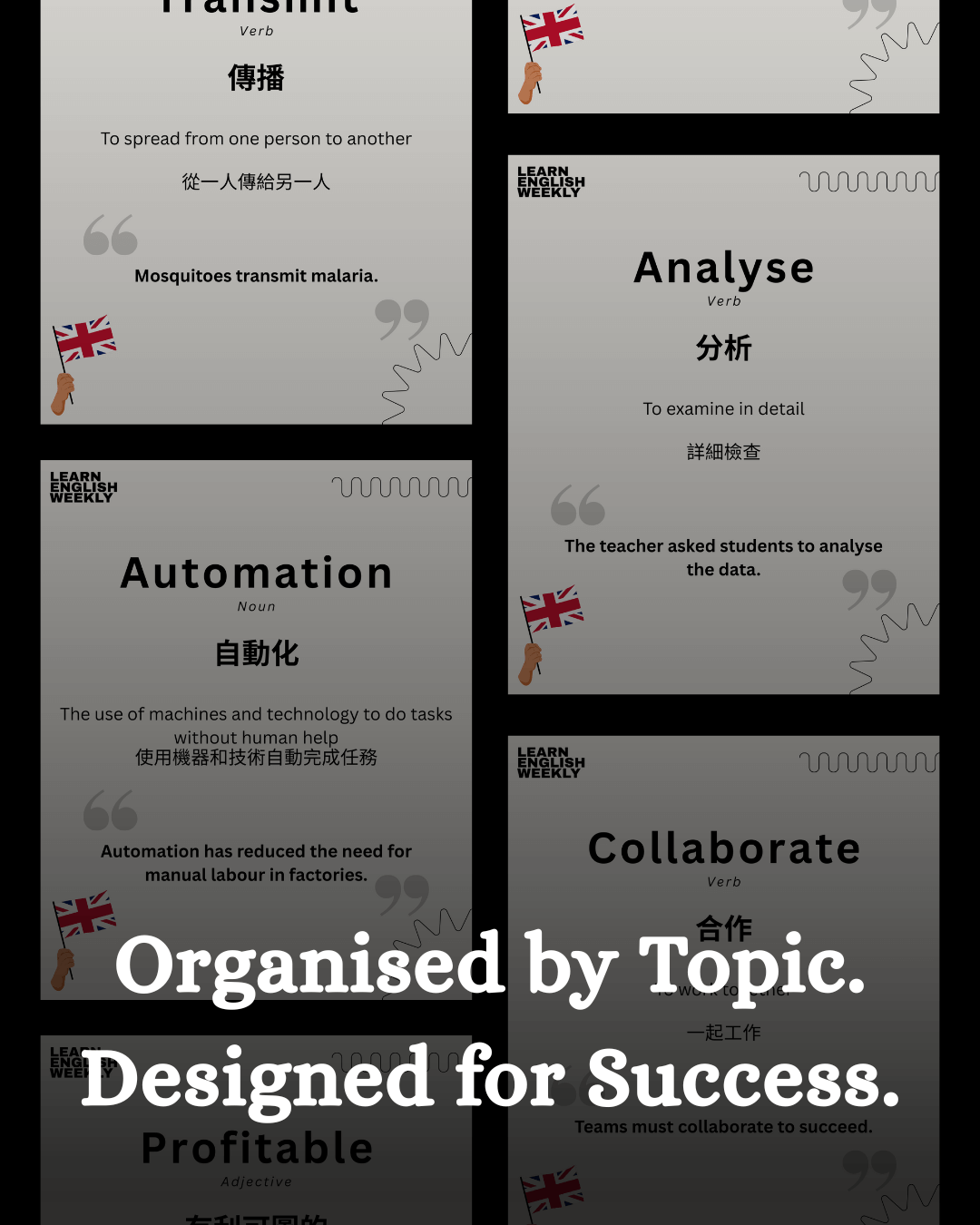
English + Traditional Chinese flashcards with real IELTS example sentences. Remember longer + boost your score. 20 Topics Included.

Education & Learning
Work & Career
Business & Economy
Technology & Innovation
Health & Medicine
Environment & Sustainability
Society & Social Issues
Government & Politics
Crime & Law
Science & Research
Communication & Media
Travel & Tourism
Culture, Art & Literature
Family & Relationships
Psychology & Emotions
Housing & Architecture
Food & Nutrition
Sports & Recreation
Philosophy & Religion
Miscellaneous Vocabulary









Erasmus Schröder, Germany
"This pack changed how I study IELTS vocab. I understand how to use the words now, not just memorise them."

Roy Wilvin, Taiwan
"The bilingual translations make learning so much easier. It definitely helped me get to band 7.5 in two months."

Roei Bahalker, Israel
"Perfect for quick revision before the test. The layout is clear and practical. I use these and watch the social media content, learning more every week!"
The evolutionary success of arthropods is largely due to this segmented body plan. Each arthromere serves as a building block that can be modified for specific functions. In many species, multiple arthromeres fuse together to form distinct body regions called tagmata, such as the head, thorax, and abdomen. This process, known as tagmosis, allows for a high degree of specialization; for example, segments in the thorax are typically optimized for locomotion (legs and wings), while those in the head are specialized for sensory input and feeding.
Understanding arthromeres is essential for studying the developmental biology of invertebrates. The blueprint for these segments is established early in embryonic development by a specific set of genes, such as Hox genes, which determine the identity and characteristics of each segment. By examining how these segments vary across different species, scientists can trace the evolutionary history of jointed animals and understand how simple, repeating units evolved into the diverse array of specialized forms seen in nature today. arthromere
If you would like to expand this into a longer paper, I can help you: Compare Detail the genetic markers that define segment boundaries The evolutionary success of arthropods is largely due
Structurally, a typical arthromere is divided into four main regions: a dorsal plate called the tergum, a ventral plate known as the sternum, and two lateral sections called pleura. These rigid plates are connected by flexible membranes, which provide the animal with the necessary range of motion while maintaining a protective exoskeleton. Appendages, such as legs or antennae, usually attach at the pleural regions of specific segments. This process, known as tagmosis, allows for a

Hi, I’m Jordan, founder of Learn English Weekly.
I’m a TEFL-qualified English teacher with over 7 years of tutoring experience, and I’ve helped hundreds of students achieve IELTS Band 7+ and beyond.
This flashcard pack was designed from real IELTS material and classroom-tested methods that actually work.
Want to talk? You can get in touch here.

Motheeb Akeel, Pakistan
"Each topic is so well organised. I focused on ‘Work and Career’ and could actually use those words in my speaking test. Totally worth it."

Andres Jiménez, Chile
"These flashcards make it so easy to study little by little every day. Highly recommended. ¡Gracias! 🙏"

Shao Hsuan Peng, Taiwan
"I love that everything is explained in both English and Traditional Chinese, perfect for quick understanding. I need to use these words every day at work!"
Take your learning further with these popular English study packs.
Join the community for free resources and other learning opportunities.
No spam — only valuable English learning content.