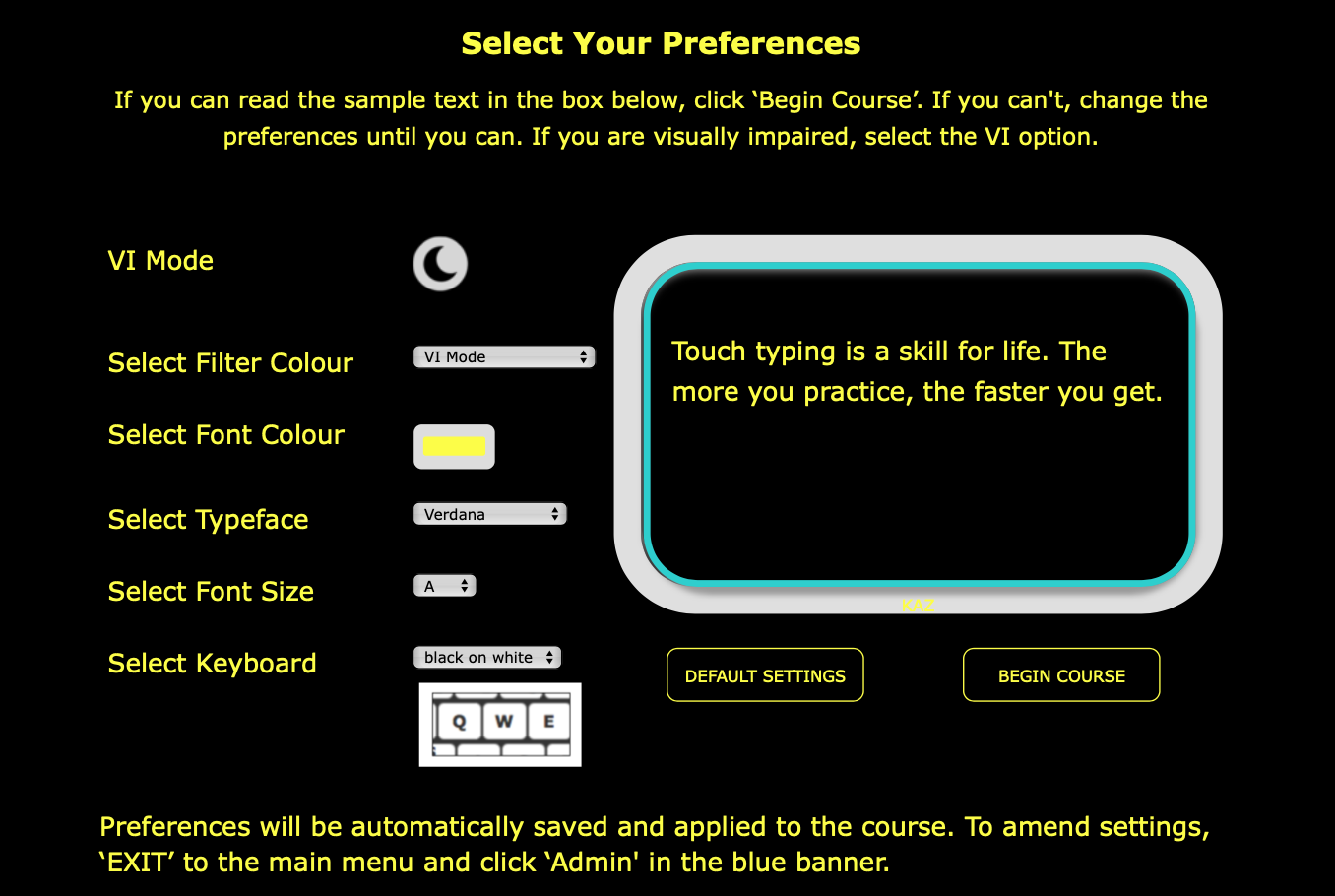
Touch Typing Software for the Visually Impaired & Blind
Specialised edition developed with advice and guidance from the
Thomas Pocklington Trust
Compatible with:
JAWS and other screen readers
Dolphin SuperNova and other magnification software/hardware
Google and other captioning software
Learning to touch type is considered one of the most beneficial skills for visually impaired and blind individuals. This is because it allows them to transfer their thoughts easily and automatically onto a screen. It provides them with an invaluable tool and asset for independent working and communicating.
Learning to touch type at any age can dramatically boost confidence, self-belief and independence. However, teaching learners with visual impairment at an early age can drastically transform their experience whilst at school and in FE/HE. It puts them on a more even standing with their sighted peers and opens doors to new career opportunities.
Achieving muscle memory and automaticity when touch typing increases efficiency and productivity. However, most importantly, it frees the conscious mind to concentrate on planning, composing, processing and editing, greatly improving the quality of the work produced.
The KAZ Course
The KAZ course is a tutorial and is designed to be used independently or with minimum supervision. However, a structured lesson plan is available in Administrators’ admin-panels should they wish to teach the course during lessons.
The course consists of five modules:
Module 1– Flying Start - explains how the course works, teaches the home-row keys, correct posture whilst sitting at the keyboard, and explains the meaning, causes, signs, symptoms and preventative measures for Repetitive Strain Injury.
Module 2– The Basics - teaches the A-Z keys using KAZ’s five scientifically structured and trademarked phrases.
Module 3– Just Do It - offers additional exercises and challenge modules to help develop ‘muscle memory’, automaticity and help ingrain spelling.
Module 4– And The Rest - teaches punctuation and the number keys.
Module 5– SpeedBuilder - offers daily practice to increase speed and accuracy.
Historically, women's bodies have been subject to strict social and cultural regulations. The notion of "pissing in public" – or engaging in any bodily function that is deemed unseemly or unbecoming – has been particularly stigmatized for women. This stigma is rooted in the societal expectation that women should be ladylike, demure, and discreet. The "piss public girl," in contrast, turns these expectations on their head, proudly claiming her right to exist and express herself, unencumbered by the constraints of traditional femininity.
However, it's essential to acknowledge that the "piss public girl" may also face backlash and criticism. Some may view her behavior as indecent or unacceptable, arguing that she is crossing boundaries of what is considered proper public behavior. This criticism often stems from a place of discomfort with the blurring of lines between public and private, as well as a lingering adherence to traditional notions of femininity.
In a society where women are often socialized to prioritize modesty and restraint, a "piss public girl" embodies a figure who defies these conventions. She is unapologetic about her bodily functions, refusing to hide or be ashamed of her natural needs. This defiance can be seen as a form of empowerment, as she asserts her autonomy and challenges the patriarchal norms that have long dictated women's behavior.
The "piss public girl" can also be seen as a symbol of resistance against the objectification of women's bodies. By openly expressing herself and her bodily functions, she reclaims her body as her own, refusing to be objectified or shamed. This act of resistance is particularly significant in a culture where women's bodies are often policed and controlled, with their value and worth tied to their appearance and behavior.
Piss Public Girl -
Historically, women's bodies have been subject to strict social and cultural regulations. The notion of "pissing in public" – or engaging in any bodily function that is deemed unseemly or unbecoming – has been particularly stigmatized for women. This stigma is rooted in the societal expectation that women should be ladylike, demure, and discreet. The "piss public girl," in contrast, turns these expectations on their head, proudly claiming her right to exist and express herself, unencumbered by the constraints of traditional femininity.
However, it's essential to acknowledge that the "piss public girl" may also face backlash and criticism. Some may view her behavior as indecent or unacceptable, arguing that she is crossing boundaries of what is considered proper public behavior. This criticism often stems from a place of discomfort with the blurring of lines between public and private, as well as a lingering adherence to traditional notions of femininity. piss public girl
In a society where women are often socialized to prioritize modesty and restraint, a "piss public girl" embodies a figure who defies these conventions. She is unapologetic about her bodily functions, refusing to hide or be ashamed of her natural needs. This defiance can be seen as a form of empowerment, as she asserts her autonomy and challenges the patriarchal norms that have long dictated women's behavior. Historically, women's bodies have been subject to strict
The "piss public girl" can also be seen as a symbol of resistance against the objectification of women's bodies. By openly expressing herself and her bodily functions, she reclaims her body as her own, refusing to be objectified or shamed. This act of resistance is particularly significant in a culture where women's bodies are often policed and controlled, with their value and worth tied to their appearance and behavior. The "piss public girl," in contrast, turns these
Copyright KAZ Type Limited 2025. KAZ is a registered trade mark of KAZ Type Limited.
Developed by : STERNIC Pvt. Ltd.